| World Jazz |
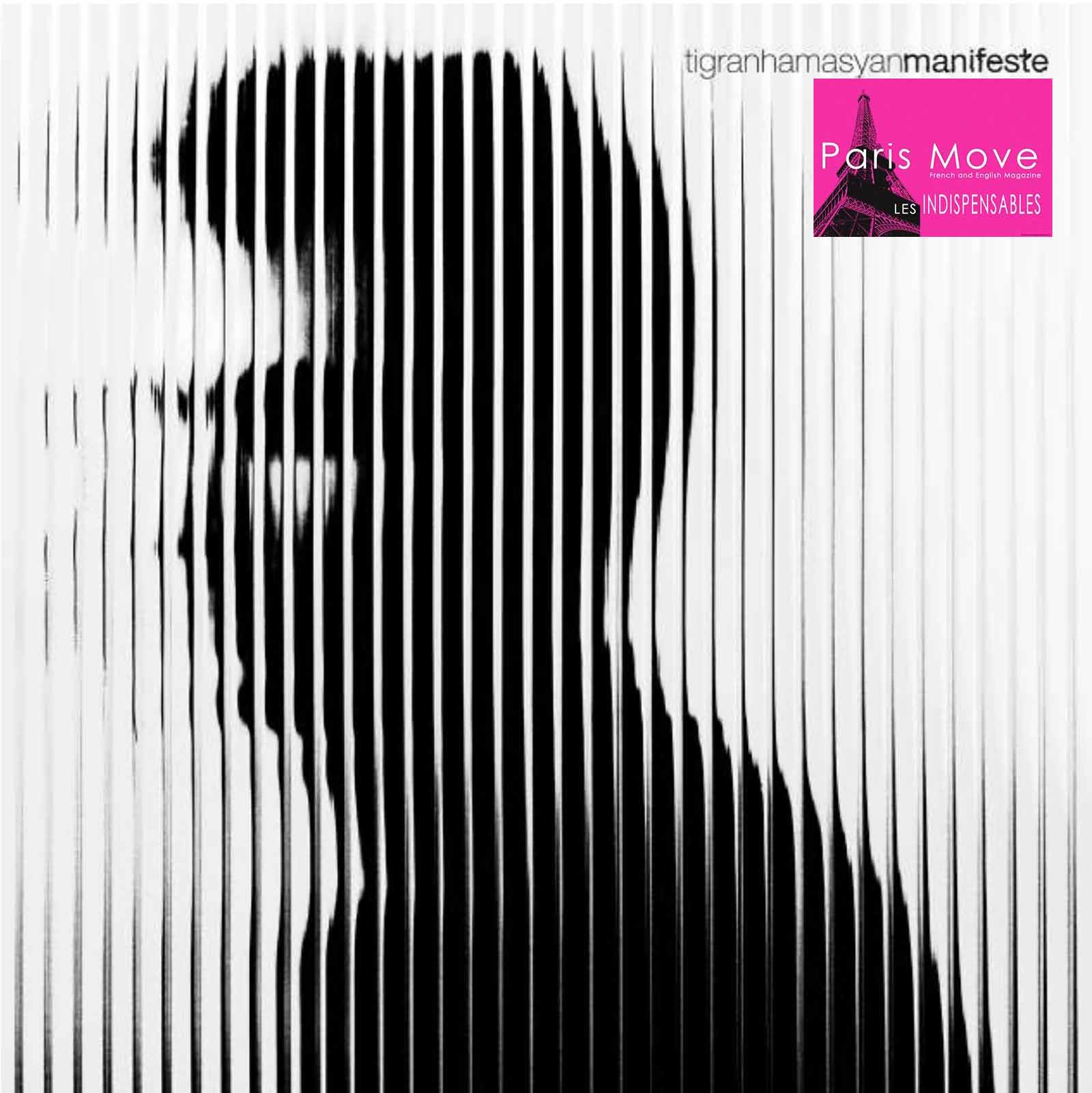
Armenian history is not merely complex; it is scarred, layered, and restless. Out of that terrain emerges Tigran Hamasyan, a composer and pianist whose music can feel cryptic to listeners unfamiliar with the cultural codes embedded within it. Yet a useful parallel may be drawn with Ryuichi Sakamoto. Both artists braid the folk memory of their homelands into contemporary forms, blending indigenous melodic language with progressive rock architecture and a searching, elastic strain of jazz.
“To search for oneself and work on oneself to discover who one is… to find something that may have always been there, but must be unearthed so that it can manifest and come alive in this world,” Hamasyan writes in his liner notes. “That moment when a musical work is born and joy fills my heart is the most precious for me, as a musician.”
On Manifeste, Armenian folklore forms the bedrock. The melodic contours frequently evoke village dances, asymmetrical meters, spiraling modal phrases, sudden dynamic shifts, while the harmonic language drifts between liturgical austerity and jazz-inflected chromaticism. In several passages, the left hand hammers out ostinatos of near-percussive violence, pushing the ensemble toward the edge of metal. Then, just as suddenly, the music contracts into near-silence: a single vocal line suspended over minimal electronics, as if emerging from the stone of an ancient monastery.
One track opens with what feels like a ritual invocation, layered voices processed through subtle digital effects, before breaking into a jagged 7/8 groove that nods toward jazz fusion. Another pivots on a stark piano motif that gradually accumulates distortion and rhythmic density, building into a cathartic climax where acoustic and electronic timbres collide. These are not decorative gestures. They are structural metaphors: rupture and resilience rendered in sound.
To understand the stakes of such music, one must reckon, however briefly, with Armenia’s history, including the trauma of the Armenian Genocide of 1915, which profoundly reshaped the nation’s demographic and cultural landscape. The memory of that rupture, and of subsequent geopolitical precarity, lingers beneath the surface of Hamasyan’s work. Armenia, a mountainous country in the Caucasus bordered by Turkey, Iran, Azerbaijan and Georgia, has long stood at the crossroads of empires. Its monasteries, many dating back more than a millennium, testify to a civilization that has endured conquest, exile and fragmentation.
For a concise historical overview, see Britannica’s entry on Armenia.
“We crystallize through suffering,” Hamasyan writes. “The role of the artist is to allow the listener to experience catharsis, to reconnect with the eternal mystery of the birth of existence, where we come from and where we return.” That philosophy permeates Manifeste. The album unites the human, the digital and the sacred in a sonic declaration where cutting-edge production meets ancestral resonance.
The production itself is telling. Hamasyan integrates acoustic piano, voice, synthesizers and intricate rhythmic programming without allowing any one element to dominate. The electronics do not sterilize the folklore; they refract it. The percussive layering, sometimes evoking progressive rock, sometimes contemporary jazz, lends propulsion, while the choral textures recall liturgical chant.
The result is neither retro revivalism nor cosmopolitan dilution. It is an argument: tradition can be expanded without being erased.
It would have been simpler for an artist of Hamasyan’s virtuosity to align with the prevailing currents of European jazz, polished, borderless, export-ready. Instead, he chooses density over accessibility, specificity over smoothing abstraction. Through Manifeste, he offers not only music but context: an excavation of origin and identity at a time when globalization often nudges cultures toward homogeneity.
The album raises quiet but insistent questions. What place does Armenia occupy in Europe’s cultural imagination? Can a small nation, numerically modest, geopolitically constrained, assert its voice without compromise? Will Armenia be recognized not merely as a site of historical tragedy but as a living cultural jewel, rich in gastronomy, architecture and artistic innovation?
In this sense, Manifeste feels urgent. The sounds and voices function as both messages and turning pages. Each rhythmic fracture, each harmonic suspension, suggests that memory is not inert; it is active, contested, alive. Hamasyan’s declaration is clear: this is where we come from; this is who we are now.
For listeners attuned to questions of humanism and cultural continuity, the album may well produce a shiver, not only aesthetic but ethical. It asks us to listen beyond comfort, to hear in complex rhythms the persistence of a people whose story is still unfolding.
Thierry De Clemensat
Member at Jazz Journalists Association
USA correspondent for Paris-Move and ABS magazine
Editor in chief – Bayou Blue Radio, Bayou Blue News
PARIS-MOVE, February 24th 2026
Follow PARIS-MOVE on X

::::::::::::::::::::::::
Musicians :
Tigran Hamasyan – piano, synths, bass synth, vocals, whistling, production, post production, drum programming
Marc Karapetian – bass
Matt Garstka – drums
Arman Mnatsakanyan – drums
Arthur Hnatek – drums, electronics, drum programming
Nate Wood – drums
Evan Marien – bass
Daniel Melkonyan – trumpet
Nick Llerandi – guitar, guitars
Artyom Manukyan – cello
Asta Mamikonyan – vocals
Hamin Honari – daf
Yessai Karapetian – blul
Yerevan State Chamber Choir conducted by Kristina Voskanyan
Track Listing :
- Prelude For All Seekers
- Yerevan Sunrise
- Manifeste
- One Body, One Blood
- Seven Sorrows
- Years Passing (For Akram)
- Dardahan
- War Time Poem
- The Fire Child (Vahagn Is Born)
- Ultradance
- E Flat Venice – Per Mané
- A Window From One Heart To Another (For Rumi)
- A Eye (The Digital Leviathan)
- National Repentance Anthem
Tour Dates:
27 Feb 2026 – Ithaca, NY, Cornell University – Bailey Hall
28 Feb 2026 – New York, NY, Irving Plaza
1 Mar 2026 – Cincinnati, OH, Ludlow Garage
4 Mar 2026 – Seattle, WA, Neptune
5 Mar 2026 – San Francisco, CA, Great American Music Hall
6 Mar 2026 – San Francisco, CA, Great American Music Hall
7 Mar 2026 – Northridge, CA, The Soraya
8 Mar 2026 – Portland, OR, PDX Jazz Festival – Alberta Rose Theater
11 Mar 2026 – Cleveland, OH, Cleveland Museum of Art
13 Mar 2026 – Chicago, IL, UChicago – Logan Center for the Arts
14 Mar 2026 – Boston, MA, Berklee Performance Center
15 Mar 2026 – South Orange, NJ, South Orange Performing Arts Center