| World Jazz |
If one were asked to name a Palestinian musician, chances are that few listeners outside specialist circles could readily offer an answer. That may be about to change. Increasingly, the name Nassim Alatrash is one to reckon with: a composer and cellist whose collaborations already span an unusually wide constellation of artists, including Ron Carter, Roger Waters, Terri Lyne Carrington, Eugene Friesen, Kenny Aronoff, Rami Jaffee, Luis Conte, Javier Limón, Jorge Drexler, Alejandro Sanz, Scott Page of Pink Floyd, and Carmine Rojas and Mike Garson of David Bowie, among many others.
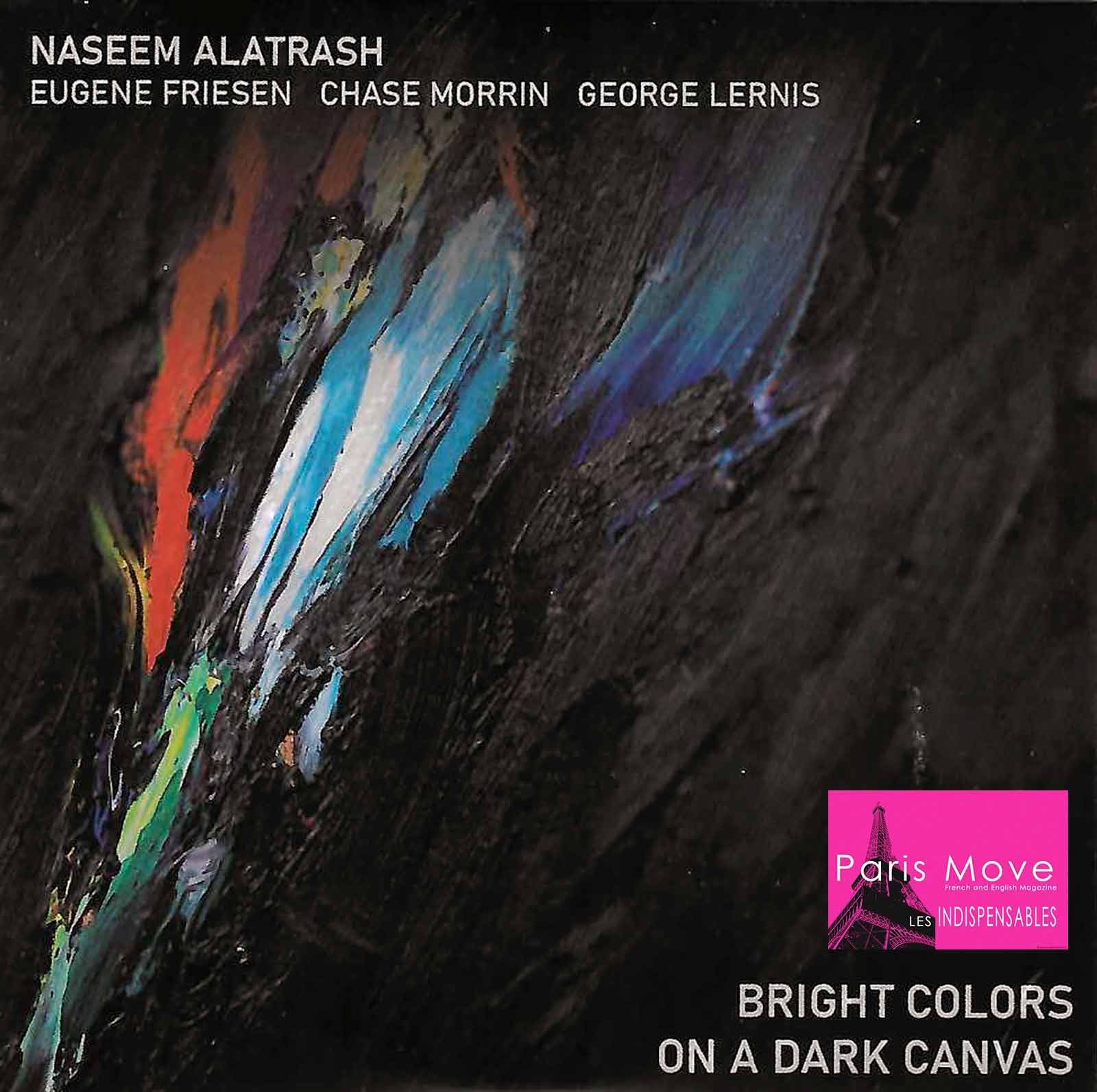
What is striking, then, is that the recording under discussion is in fact Alatrash’s first album. It is, by any reasonable measure, a remarkable debut, an assured and often breathtaking work presented in an orchestral form that quickly reveals the breadth of the composer’s artistic universe. While the cultural roots of the Arab world are clearly present, they serve less as a boundary than as a structural foundation upon which Naseem Alatrash builds, traveling musically across continents and traditions. The result is a body of work that feels attentive to the wider world, expansive in scope and intention.
Listeners encountering Bright Colors On A Dark Canvas for the first time may be struck by its sense of narrative movement. The opening passages unfold with restrained, almost meditative string textures before gradually introducing rhythmic figures that draw on Latin traditions; in later sections, modal lines and ornamentation hint at Andalusian and Middle Eastern forms. Percussion and low strings often function as an undercurrent, creating a cinematic sense of space, while solo cello lines rise and recede like a voice in conversation with the ensemble. The pacing is deliberate, the dynamics carefully shaped, and the orchestration frequently favors clarity over density, allowing individual instrumental colors to emerge.
His trajectory offers ample evidence of the discipline and preparation behind the music. Alatrash studied at the Edward Said National Conservatory of Music in Palestine, earning both bachelor’s and master’s degrees in cello performance, and later received a post-master’s fellowship at the Berklee College of Music, where he was awarded a Presidential Scholarship for excellence. Such training is evident not only in the technical assurance of his compositions but also in their structural ambition.
The album was recorded in sessions that brought together musicians from several countries, an international collaboration that mirrors the global vocabulary of the music itself. The production favors an acoustic, spacious sound, placing the listener close to the instrumental timbres rather than overwhelming them with studio effects. This approach reinforces the sense that the work is intended to be heard as a living, breathing performance rather than a purely polished artifact.
The album’s title, Bright Colors On A Dark Canvas, invites interpretation. One may reasonably read in it a gesture toward political engagement and a search for peace, an aspiration long voiced by many Palestinian artists, whether musicians, writers, or visual creators. Their work often serves as a reminder that populations are not, by nature, inclined toward conflict, and that the longing for dignity, coexistence, and respect is both universal and enduring. Art, in this sense, becomes not merely an expression but a quiet act of resistance and hope.
In discussing the project, Alatrash has spoken about the emotional impulses behind it, noting in an interview that he was drawn to the idea of “finding light without denying the darkness that exists.” That sensibility is evident throughout the album, where passages of tension are often followed by moments of lyrical calm, as if the music itself were searching for equilibrium.
What fascinates most in Alatrash’s compositions is the interplay of influences. The language of contemporary classical music is never far from the surface, yet it intertwines with Latin idioms and, at times, echoes of Andalusian tradition. These elements do not dilute the music’s identity; rather, they deepen its complexity, lending the works a carefully shaped dramaturgy that sustains the listener’s attention from one movement to the next. In this sense, the album can be situated within a broader movement of composers who blur boundaries between classical, jazz, and global traditions, a field that has grown steadily in recent decades as audiences have become more receptive to hybrid forms.
To reflect more broadly on the nature of artistic creation is to recognize how inseparable it is from personal history. To create a work of such emotional and structural richness requires more than technical mastery: it demands the capacity to feel, to understand, and ultimately to absorb one’s own experience before offering it to the world in transformed form. In Alatrash’s music, what emerges with particular clarity is a profound humanism. It is difficult to imagine such works being written without an inner life shaped by empathy, memory, and reflection. Nostalgia and compassion seem to function here as guiding threads. His playing, it is worth noting, has been described by the Chicago Tribune as possessing “a particularly brilliant tone.”
Yet tone alone does not account for the impact of this album. What lingers are the intentions behind the sound. This is a work best approached as a whole, each chapter inseparable from the others in revealing the larger artistic vision. Listeners familiar with this musical territory may hear affinities with the kind of work that attracts major artists, figures such as the guitarist and composer Juan Carmona, for example. But there is something more here than craftsmanship or beauty of sound. There is lived experience, distilled and reshaped, and the listener is left with a sense of deep respect for a work that quietly reawakens a shared humanity.
If this debut is any indication, Naseem Alatrash stands at the beginning of a career that may well broaden the international visibility of Palestinian composers and performers. More than that, it suggests the emergence of a musical voice capable of speaking across borders, one that reminds listeners, in an increasingly fragmented world, that art still possesses the rare power to connect, to console, and to illuminate.
Thierry De Clemensat
Member at Jazz Journalists Association
USA correspondent for Paris-Move and ABS magazine
Editor in chief – Bayou Blue Radio, Bayou Blue News
PARIS-MOVE, February 5th 2026
Follow PARIS-MOVE on X

::::::::::::::::::::::::
Musicians :
Naseem Alatrash, cello/composer
Chase Morrin, piano
George Lernis, percussion
Bruno Raberg, acoustic bass
1st Violins: Bengisu Gokce, Lilit Hartunian, Greta Myatieva, Heeyeon Chung, & Aija Reke
Track Listing:
Prelude
Riwaya
Ramad (ashes)
Li fta
Echoing In The Hollow
Risala – Part 1
Risala – Part II