
| Latin Jazz |
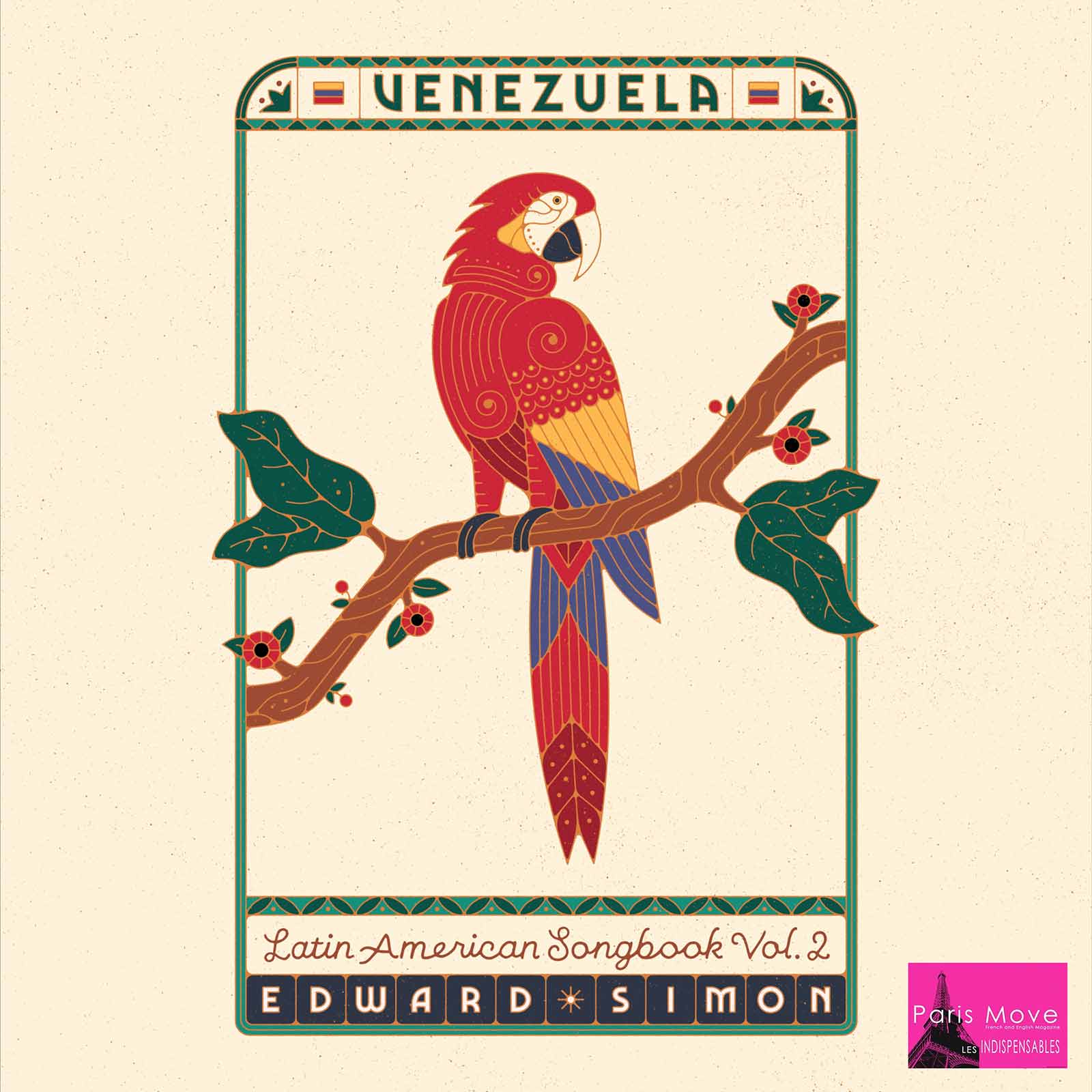
This album does not behave like a jazz record so much as it unfolds like a work of modern classical music, one shaped, colored, and animated by the rhythmic and melodic pulse of Latin America. That framing is essential to understanding Edward Simon’s artistic intent. He is, above all, a composer, and while Latin musical traditions clearly inform his language, they are not treated as decorative influences. They are structural elements, embedded in the harmonic logic, the rhythmic architecture, and the emotional trajectory of the music itself.
Across a career spanning more than three decades, Simon has quietly but persistently built bridges between jazz and the musical traditions of Latin America, crafting a body of work that resists hierarchy. Jazz is not privileged over folklore, nor is tradition frozen in nostalgia. Instead, Venezuela: Latin American Songbook Vol. 2 functions as a living conversation, one that draws from the cultural memory of Simon’s native Venezuela and its neighboring countries while engaging fully with contemporary improvisational thought. In an era when globalization often flattens musical identity into marketable shorthand, this album feels like a deliberate act of preservation: a reaffirmation that cultural lineage can evolve without being diluted.
This is not a stylistic exercise, nor a museum-like reconstruction of inherited forms. It is an album driven by conviction and emotional investment. The trio’s playing is nothing short of remarkable in its balance of precision and freedom. There are moments when the music seems to breathe collectively, as if shaped by a shared internal clock rather than explicit cues. One cannot help but hear strong affinities with contemporary Cuban music, particularly in the elasticity of the rhythms and the understated complexity of the groove, even though Simon himself is Venezuelan. In truth, throughout Latin America, as in much of Europe, a musician’s path often begins with classical training. That foundation is unmistakable here, both in the formal clarity of the compositions and in the architectural intelligence of the arrangements.
Simon’s piano playing deserves particular attention. His touch is deliberate, measured, and deeply lyrical, favoring clarity over excess and resonance over display. He constructs voicings that feel carefully weighted, allowing harmonies to linger just long enough to register emotionally before dissolving into silence. Space plays a crucial role in his phrasing, and his interaction with the rhythm section is rooted in trust rather than dominance. The trio operates less as a soloist with accompaniment than as a chamber ensemble, each voice contributing to the narrative with restraint and purpose.
Born in Punta Cardón, Venezuela, and long based in the San Francisco Bay Area, Edward Simon is a Guggenheim Fellow, a recipient of a Chamber Music America New Jazz Works grant, and a member of the SFJAZZ Collective since 2009. DownBeat has described him as “one of the most gifted pianists of his generation,” a reputation reinforced by a strikingly diverse list of collaborators, including Paquito D’Rivera, Terence Blanchard, Bobby Watson, Magos Herrera, Don Byron, Luciana Souza, Mark Turner, Donny McCaslin, Chris Potter, David Binney, Dianne Reeves, and John Patitucci.
What draws such artists to Simon’s music becomes immediately apparent upon close listening. There is depth here, conceptual, emotional, and cultural. Simon’s voice is unmistakable, marked by a rare ability to integrate multiple musical languages without forcing them into obvious contrast. Elements of Latin musical tradition surface in subtle, almost subliminal ways, often carried by rhythmic nuance rather than overt quotation. These gestures reward patience and repeated listening, revealing layers that resist instant consumption.
Edward Simon is not the most immediately accessible figure in today’s international jazz landscape, but he is unquestionably one of its most inventive. His work asks something of the listener: attention, curiosity, and a willingness to engage with complexity. In return, it offers music of lasting value. These compositions feel durable, capable of being reinterpreted, reimagined, and claimed by future generations of musicians. In that sense, they already belong to a tradition larger than their creator.
Recorded on January 28 and 29, 2025, at Tin Roof Studio in Sonoma, California, the album features six compositions arranged and produced by Simon himself. The high-fidelity production, engineered and mixed by Jeff Cressman and mastered by Nate Wood, captures every detail with remarkable transparency. The listening experience evokes the immediacy of a live performance, minus the audience: with a quality sound system, the spatial precision of each instrument is striking. From start to finish, the album sustains a rare level of focus and intimacy, leaving the listener with a single, persistent desire, to hear this trio onstage, where this music can fully unfold in real time.
Thierry De Clemensat
Member at Jazz Journalists Association
USA correspondent for Paris-Move and ABS magazine
Editor in chief – Bayou Blue Radio, Bayou Blue News
PARIS-MOVE, January 18th 2026
Follow PARIS-MOVE on X

::::::::::::::::::::::::
Musicians :
Edward Simon – piano
Reuben Rogers – bass
Adam Cruz – drums
Jackeline Rago – cuatro, maracas (track
Track Listing :
- Presagio (8:26)
- Atardecer (7:06)
- Dama Antañona (17:50)
- Anhelante (5:10)
- El Vuelo de la Mosca (4:49) featuring Jackeline Rago
- Sabana (7:03)