| Jazz |
Finding Joy in Vulnerability: Isabelle Bodenseh’s Dignity Reimagines Jazz Through the Bass Flute
Some albums announce themselves with virtuosity. Others arrive quietly, asking only for time and attention. Isabelle Bodenseh’s Dignity belongs firmly to the latter. It does not demand the listener’s admiration; it earns it, patiently, through sound, breath, and an unwavering sense of humanity.
On a Sunday morning, with a cup of Lavazza still steaming and the world outside not yet awake, I put on my headphones. What emerges first is the sound of a bass flute, intense, deep, almost spellbinding. It blurs the uneasy feeling of a morning that seems to begin too early, replacing it with something warmer, more deliberate. As with many European musicians and composers, the intention is immediately clear: this is music positioned at the intersection of jazz, classical tradition, and folk sensibility. One might even describe it as jazz with a distinctly European identity, reflective, narrative, and unafraid of silence.
Understanding what lies behind Dignity makes its emotional impact impossible to ignore. The album is inspired by the life of Bodenseh’s daughter Juliette, who lives with a severe disability. Yet this is not a record weighed down by tragedy. Bodenseh transforms moments of vulnerability, resilience, and connection into a musical journey that feels remarkably light on its feet. Dignity does not portray fragility as weakness. Instead, it frames dignity itself as something vibrant and joyful, tender, humorous, and alive.
The choice of a suite format is crucial. It gives Bodenseh the space to link multiple emotional chapters into a broader narrative arc, allowing the music to unfold with patience rather than urgency. Each movement feels connected, yet autonomous, like moments in a life that only reveal their meaning when viewed together.
More broadly, this soothing music proves to be far more intense than it initially appears. It unfolds like a canvas of free expression, where each musician contributes their own dimension, projecting imagination and nuance. There is a deep sense of humanism here, paired with a poetic language that feels unmistakably contemporary. This is not music that seeks to impress through complexity alone, but one that invites listeners into a shared emotional space.
At the heart of the album lies Juliette, a striking sonic collage that blends bass flute improvisation with fragments of family conversations. Juliette’s breathing, a burst of laughter, and the voices of Bodenseh’s husband and son bring an intimate human presence into the music. These elements are not used for effect; they are integrated organically, forming the epilogue toward which the entire suite gently flows. The result is profoundly moving without ever becoming intrusive.
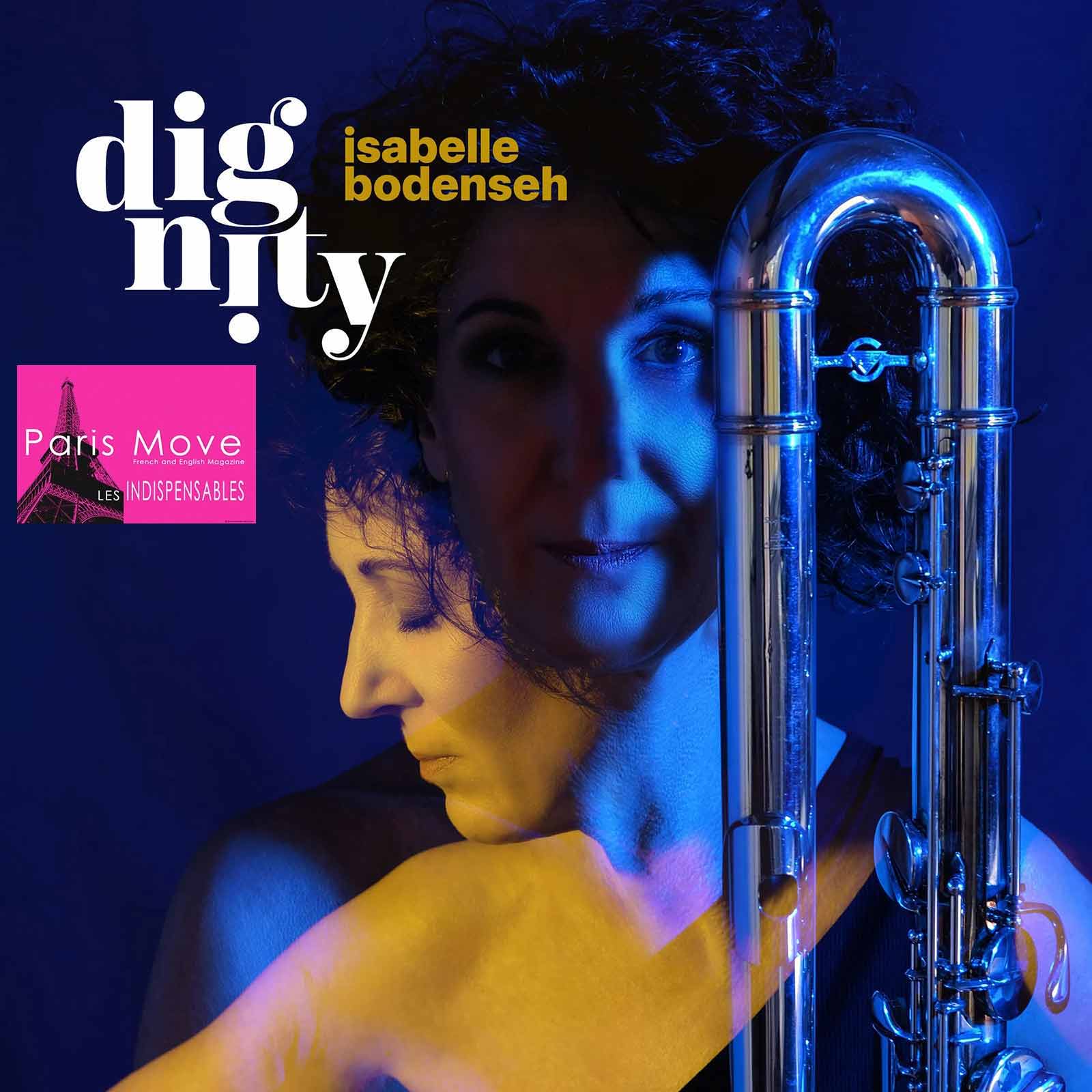
Dignity is compelling on many levels. One of the most striking is Bodenseh’s choice of instrument. The bass flute remains a rarity in this type of musical setting, where most flutists rely on the traditional concert flute. Here, the bass flute assumes a role closer to that of a tenor saxophone. It can slide into the ensemble with warmth and roundness, turn sharp and assertive when needed, or even evoke an almost ethnic coloration. Bodenseh exploits the full expressive range of the instrument, making it both anchor and narrator.
Beyond its sonic identity, Dignity raises an essential question: What undermines human dignity, and how can it be preserved? Through lyrical openings, rhythmic energy, moments of serene contemplation, and lively musical interactions, Bodenseh suggests that human connection itself can transcend the rigidity of systems and institutions. In this sense, the album subtly gestures toward broader societal concerns, disability, care, autonomy, and the often-impersonal structures that govern modern life, without ever becoming didactic.
“This music was born from lived moments, some exhilarating, others more difficult, but always in motion,” Bodenseh explains. “It is not tragic. It is full of life.” That philosophy permeates every note of the album.
Indeed, this humanity may be Dignity’s defining signature, but it is far from its only strength. Beneath its apparent gentleness lies a music that is intellectually far more complex than it first appears. Bodenseh has already forged a strong artistic identity through her command of the bass flute, mastering every aspect of the instrument with remarkable precision. She shapes entire sound worlds at will, allowing the compositions to breathe and offering generous space to each instrumentalist. This creates a sense of osmosis within the ensemble, reinforcing the poetry and fluidity of the project.
Yet make no mistake: this is demanding music. Its complexity lies not in virtuosity for its own sake, but in balance, between structure and freedom, intimacy and abstraction, personal narrative and collective expression. When one considers the ambition behind Dignity, respect is owed not only to its theme, but also to Bodenseh’s qualities as both instrumentalist and composer.
For listeners who enjoy being surprised by projects that are both emotionally engaging and artistically rigorous, Dignity is more than a recommendation. It is an invitation, to listen differently, to embrace vulnerability as strength, and to rediscover dignity not as an abstract concept, but as a living, breathing force.
Thierry De Clemensat
Member at Jazz Journalists Association
USA correspondent for Paris-Move and ABS magazine
Editor in chief – Bayou Blue Radio, Bayou Blue News
PARIS-MOVE, January 12th 2026
Follow PARIS-MOVE on X

::::::::::::::::::::::::
Musicians :
Isabelle Bodenseh | Flutes
Thomas Bauser | Hammond Organ
Johannes Maikranz | Guitar
Lars Binder | Drums
Track Listing:
Part I – Prolog
Part II – Sospeso
Part III – Tempesta
Part IV – Kantilene
Part V – Verve
Masha
Fly High
Juliette
Masha (Lars Binder)
Fly High (Isabelle Bodenseh)
Juliette (Isabelle Bodenseh & Johannes Maikranz)
Background info/ Liner Notes:
Production: Isabelle Bodenseh
Composition & Arrangements: Isabelle Bodenseh, Johannes Maikranz, Lars Binder
Recording, Mix & Mastering
Recording: 2.-6. February 2025,
Klaus Genuit, Hansahausstudios, Bonn