| Jazz |
Marantz, hailed by NPR as “one of the finest young American jazz pianists” and by DownBeat as “a pianist who paints with musicality at the keyboard”, brings a quietly radical imagination to this project of striking beauty. His playing here is neither demonstrative nor nostalgic; instead, it unfolds with a patience and confidence that suggest a musician fully aware of his own voice. That alone is reason enough to listen.
His partner, guitarist Simon Jermyn, arrives with a pedigree deeply rooted in the most exploratory corners of contemporary jazz. A longtime presence within New York’s avant-garde ecosystem, Jermyn has collaborated with figures associated with John Zorn’s orbit and beyond—musicians such as Jim Black, Chris Speed, Gerald Cleaver, Mat Maneri, Ingrid Laubrock, Tony Malaby, Anna Webber, Ben Goldberg, Allison Miller, Nate Wood, and Tom Rainey. These associations matter: they signal an aesthetic where risk, form, and improvisation are not opposing forces but interdependent ones.
From its opening moments, the album announces itself less like a traditional jazz record than like the beginning of a film. A sonic setting takes shape almost immediately, a carefully lit soundscape that draws the listener in and refuses to let go. Just as one begins to acclimate, the music pivots. The second track opens a different emotional and textural space altogether, making it clear that this project thrives on contrast. Expectations are gently but persistently unsettled.
At the piano, Marantz often works with repeating figures, motifs that echo minimalist traditions yet remain unmistakably jazz-inflected. These patterns are not static loops but living organisms, subtly reshaped through touch, harmony, and time. Against this, Jermyn’s guitar alternates between atmosphere and articulation, sometimes blending seamlessly into the piano’s resonance, sometimes cutting across it with angular clarity. The result is a music whose architecture is deliberately complex: ideas arrive from multiple directions at once, and the ear is left searching, joyfully, for a stable center.
This sense of productive disorientation is one of the album’s great pleasures. It feels unique, unmistakably its own. One hears, faintly but unmistakably, the influence of artists like Vangelis and Peter Gabriel, not in any direct stylistic borrowing, but in the cinematic breadth of the sound and in its emotional immediacy. Like the best work of those artists, this music understands space as narrative and texture as meaning. Yet it is never derivative. The “elsewhere” it gestures toward belongs entirely to these two musicians.
Jazz and rock intermingle here with quiet assurance, joined by subtle traces of global musical languages. Nothing feels forced; the transitions are organic, almost inevitable. The album occupies a liminal zone, somewhere between the novel and what might be called the fifth art, cinema, where sound suggests story without ever insisting on one. In this sense, Marguerite Yourcenar feels like an apt, if unexpected, reference point. Known for her erudite candor, she once replied to a Radio France journalist with the phrase, “Allow me to wander.” That permission, to digress, to explore without apology, seems woven into the DNA of this music.
This is not simply a sequence of compositions but a genuine listening experience, a journey whose destination is deliberately left undefined. It is difficult not to speculate about how this material will evolve onstage. The structures are clearly designed to breathe, leaving ample room for improvisation and reinvention. One suspects that in performance, the balance between form and freedom may shift dramatically from night to night, altering the music’s emotional weight and internal logic.
From a strictly personal perspective, this album feels like a true beginning. Not merely a first release, but the opening chapter of a collaboration still in motion. Form and content already intersect with rare intelligence, revealing a conceptual framework that is visible without being exhausted. The full substance remains just out of reach, and that restraint feels intentional.
A piano–guitar duo is among the most delicate formats in improvised music, demanding constant negotiation of space, role, and momentum. Here, the foundations are firmly laid. What comes next will require time: time to mature a shared language, to test it under the pressure of live performance, to refine instinct into inevitability. If this album is any indication, that process may place Marantz and Jermyn among the most quietly compelling voices shaping the future contours of contemporary jazz.
Thierry De Clemensat
Member at Jazz Journalists Association
USA correspondent for Paris-Move and ABS magazine
Editor in chief – Bayou Blue Radio, Bayou Blue News
PARIS-MOVE, December 26th 2025
Follow PARIS-MOVE on X

::::::::::::::::::::::::
Musicians :
Luke Marantz, piano
Simon Jermyn, guitar
Track Listing :
Echoes
Country
Hovering
Echoes II
Shori
Light Scatters Green
Echoes III
Passages
Echoes IV
All compositions written by Luke Marantz and Simon Jermyn and published by CAC Music Publishing (BMI).
Luke Marantz, piano, synthesizers, rhodes; Simon Jermyn, electric guitar and electric bass; Josh Dion, drums
Executive Produced by Chris Leon, Andrew Horowitz, Coyle Girelli, Julian Shore
Produced by Luke Marantz and Simon Jermyn
Recorded at MAV Studios in Brooklyn, NY
Engineered by Matt Marantz
Mixed by Matt Marantz
Mastered by Chris Leon at Boomtown Studios, Brooklyn, NY
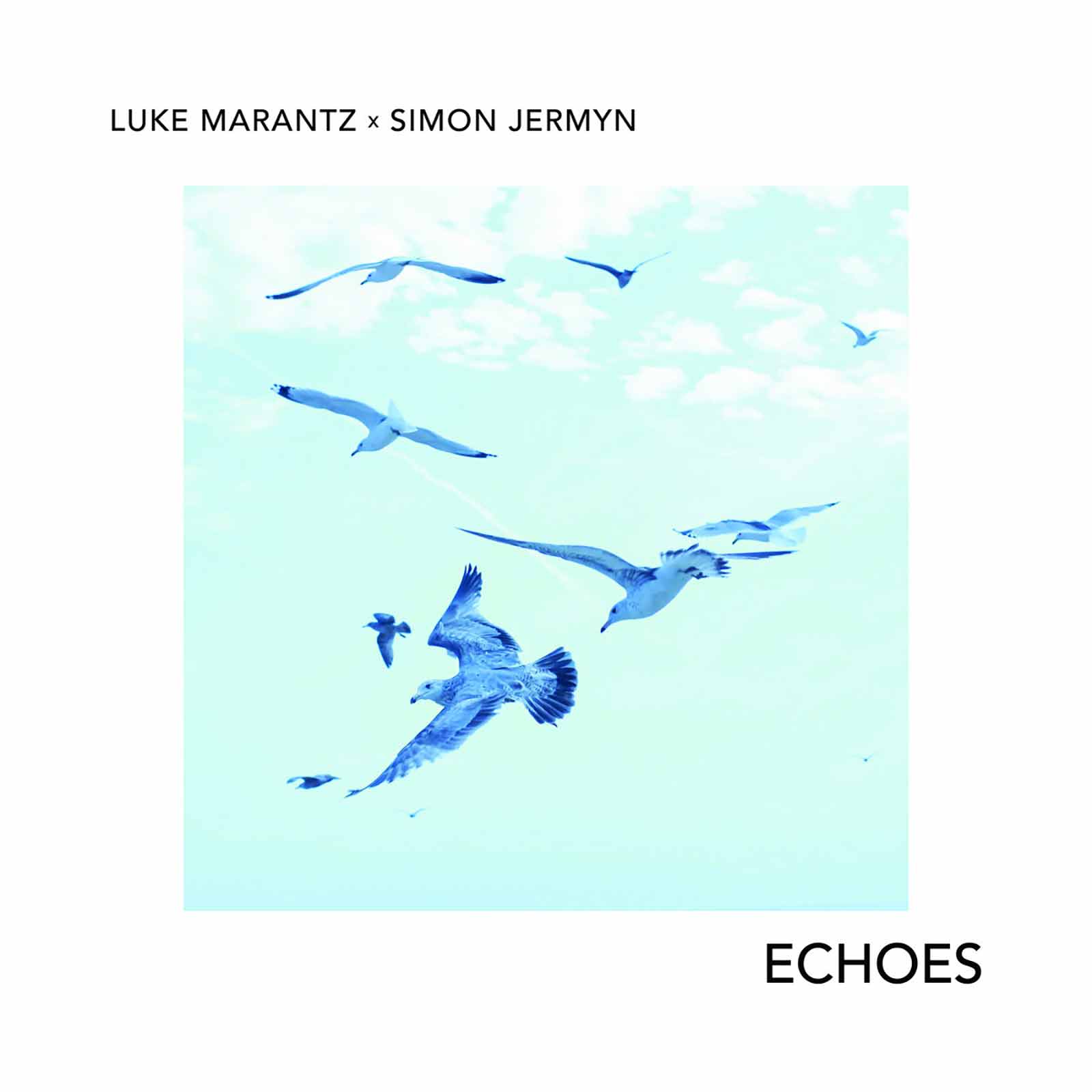
Cover Photo by Luke Marantz
Album Design by Livia Blanc