| Classique, Jazz |
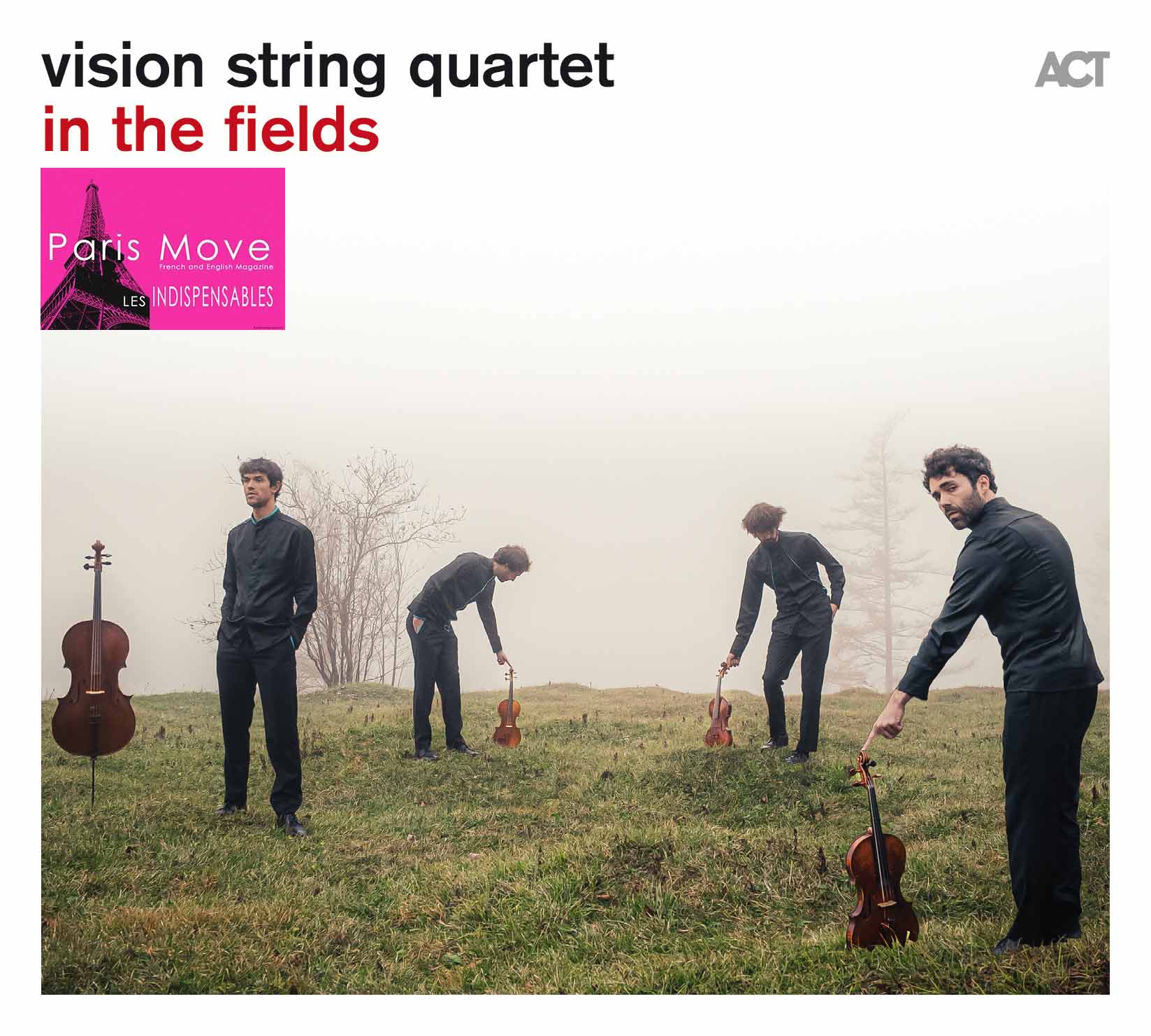
There are albums that invite listening, and then there are albums that demand excavation, works that feel less like recordings than like layers of sediment waiting to be brushed free, patiently, by the listener’s imagination. This new offering by the Vision String Quartet belongs unmistakably to the latter category: a musical site where history, folklore, modernity, and creative instinct converge with an almost archaeological precision.
At first glance, one might assume the album is aimed primarily at admirers of classical music or aficionados of particular folk traditions. And perhaps that is true. ACT, after all, is a label notorious for drifting, deliberately, provocatively, far beyond the barges of traditional jazz, heading instead toward territories where Roma motifs, classical rhythmic codes, and pan-European folk idioms intermingle freely. But to describe this record merely by its likely audience would be to overlook the wider cultural moment it inhabits. We live in an era where genre boundaries have dissolved like old borders on a map; the quartet steps into that dissolution with the confidence of artists who see freedom not as a risk but as a birthright.
The album unfolds as a sequence of sonic tableaux, each one chiselled with the care of an artifact being unearthed from centuries of dust. One could call it a kind of chamber-sized symphonic mural, its color palette borrowed from eras older than our own, yet its internal cohesion surprisingly modern. The group’s interplay is taut, luminous, almost telepathic. The works they present adhere to a logic so precise, so internally consistent, that the music attains a paradoxical blend of romantic sweep and sharp-edged vitality. It is the kind of record capable of seizing the wandering attention of any passerby whose ear might drift within orbit of the Vision String Quartet.
Much of this structural coherence derives from the album’s principal architectural model: Béla Bartók’s five-movement String Quartet No. 4. For the quartet’s members, Bartók is more than an influence, he is a tutelary voice, a spiritual compass, the original fieldworker whose ethnographic forays into the villages and plains of Europe opened the path they now walk. “We’ve been infected by his fascination with what is both familiar and unknown,” the musicians note, inviting listeners to follow them into the subterranean chambers of this music, where ancestral rhythms echo like footprints preserved in clay.
Bartók himself, long the beloved tormentor of conservatory students across Europe, created works whose narrative complexity is matched only by their ferocious elegance. He almost certainly would not have written the violin and viola parts the way they appear here; this is where the quartet asserts its authorship, placing its signature firmly atop the score. And yet in the rhythmic scaffolding, in the evolving pulse of each movement, one finds unmistakable kinship with Bartók’s original architecture. At moments, scents of 19th- and early 20th-century Spanish or Argentine repertoire drift through the air, as though the music had briefly passed through a sunlit courtyard before returning to the dimmer, more haunted spaces of Central and Eastern Europe.
One might argue that the track titled “String Quartet No.4, 2nd Movement, Percussive Dimensions” is the album’s most arresting excavation, a crossroads where contemporary classical grammar meets global folk expression, a daring aesthetic trespass of the sort that reminds us why music exists in the first place. And if listeners follow the album’s logical succession closely, by the time the fifth movement arrives they may find themselves facing a work arguably more gripping, more visionary, than much of what European classical composers have offered since the early twentieth century.
It is worth pausing here for a digression, one that concerns ACT itself. In an age when the classical record industry has contracted and the jazz world often fears its own shadow; ACT persists as one of the few labels willing to occupy the no-man’s-land between traditions. Its catalog is strewn with artists who color outside the prescribed lines, who treat genre not as a container but as a constellation. In that sense, ACT has become a kind of sanctuary for projects like this one, albums that, in another era, might have been welcomed by Harmonia Mundi or some other guardian of adventurous classical repertoire. Today, it is ACT that keeps this particular frontier alive.
Returning to the music, one can observe a pattern shared with today’s most forward-looking jazz artists: that dialectic between past and present, that instinctive respect for history paired with an appetite for reinvention. Here, the quartet embraces a classical lineage without apology, Bartók, Ravel, Dvořák, but reframes it through a contemporary lens, enriching it with a dose of mystery, angularity, and modern emotional intelligence. At some point, one might wonder whether citing these influences even matters: the works stand convincingly on their own. When the fifth movement bursts forth, a kind of mythic charge at full gallop, it feels as though an ancient horseman has suddenly appeared in the clearing, not to reenact the past but to claim it anew.
What the quartet achieves is not adaptation but reinterpretation: a re-writing of the inherited canon that restores its urgency, its strangeness, its original sense of wonder. They treat the classical tradition not as a museum display but as a living terrain still capable of yielding new artifacts, new truths, if one digs deep enough.
Above all, this album is a sonic experience before it is even an artistic one, a rare mineral extracted from a seam that few contemporary ensembles dare to explore. It reminds us that the boundaries between genres are porous, that musical history is not a linear progression but a landscape of buried paths waiting to be rediscovered. And perhaps most importantly, it affirms that in a cultural era dominated by speed, metrics, and instant consumption, there remains a place, an urgent need, for works that resist simplification and reward patient listening.
If the Vision String Quartet is excavating the past, it is only to illuminate the present. And if ACT is giving these works a platform, it is because the future of music may depend on precisely this kind of audacious, boundary-erasing artistry.
Thierry De Clemensat
Member at Jazz Journalists Association
USA correspondent for Paris-Move and ABS magazine
Editor in chief – Bayou Blue Radio, Bayou Blue News
PARIS-MOVE, December 8th 2025
Follow PARIS-MOVE on X

::::::::::::::::::::::::
Musicians :
Florian Willeitner: violin
Daniel Stoll: violin
Leonard Disselhorst: cello
Sander Stuart: viola
Guests :
Joel Lyssarides: piano (#1, 3, 6, 7, 9, 14)
Mahan Mirarab: guitar (#11, 12)
Bernhard Schimpelsberger: percussion (#4, 10)
Tracklisting :
Kopanitsa
String Quartet in F Major, 2nd Movement
Ravel Reloaded
String Quartet No.4, 2nd Movement, Percussive Dimensions
String Quartet No.4, 3rd Movement
Lydian Rose
Grimasch Om Morgonen
String Quartet No.13, 3rd Movement
Dvorak reloaded
String Quartet No.4, 4th Movement, Percussive Dimensions
Raindance
Convalescence
String Quartet No.4, 5th Movement
Skymning
Recorded between 7–12 October 2024 and 29–30 October 2024 at Studio.1, BR Franken, Nürnberg
Produced by vision string quartet
Executive producer for BR: Beate Sampson
Recording producer, engineer, editing, mixing: Christian Jaeger
Recording and editing technician: Tatjana Schewtschenko
Piano tuner: Theo Kretzschmar
Mastered by Christoph Stickel, Vienna
The ACT Agency presents:
vision string quartet live 2025/26
01.12. Düsseldorf, Tonhalle
02.12. Coesfeld, Konzerttheater
06.12. Bensheim, Parktheater
10.12. Berlin, Philharmonie
08.01. Hamburg, Elbphilharmonie
11.01. Seon (CH), Reformierte Kirche
24.01. Lauenau, Sägewerk
25.01. Bremen, Hochschule für Künste
27.01. Oslo (NO), Gamle Logen
28.01. Bergen (NO), Grieg Heritage Hotel
08.02. Gent (BE), De Bijloke
14.02. Berlin, Zitadelle Spandau
24.02. Hamburg, Elbphilharmonie
27.02. Aschaffenburg, Stadttheater
01.03. Aachen, Krönungssaal
04.03. Düsseldorf, Tonhalle
06.03. St. Gallen (CH), Tonhalle
08.03. Zürich (CH), Tonhalle
05.04. London (UK), Wigmore Hall